  1. Home
  2. Book NFTs

Book NFTs

Limited-edition eBook collectibles. Each mint is a numbered copy of the book, recorded on the blockchain, with access reserved for owners.

The latest from White Falcon

Technology-first publishing, now on-chain

White Falcon Publishing has always been at the forefront of new-age, technology-driven solutions for the publishing industry: print-on-demand, a dedicated author platform, blockchain timestamping for books (the first Indian publisher to introduce it, in 2019), and tools we build ourselves rather than outsource.

Book NFTs are the latest product in that mission. They turn a title into a limited edition eBook collectible: a fixed number of identical digital copies, each uniquely numbered, each owned by a reader’s wallet.

  • One book, a finite edition run, not an unlimited file share
  • Ownership lives on a public blockchain, not a private account
  • Holders unlock the read-only eBook from our minting site
In plain language

What is an NFT?

An NFT (non-fungible token) is a unique digital certificate stored on a blockchain. Unlike a currency token, where every unit is interchangeable, each NFT is distinct. It can prove who owns a particular item, when it was created, and that it belongs to a specific collection.

For books, that item is a numbered edition of the eBook. The token is not a replacement for copyright or print publishing. It is on-chain proof that the holder owns one copy in a limited run, and the key we use to unlock the reading experience.

Collectors use a wallet, like MetaMask, to mint and hold their edition. The same wallet later opens the gated eBook.

Open standard

Built on ERC-721 editions

Book NFTs use the widely adopted Ethereum NFT standard, structured as an editions collection: one work, many identical numbered copies.

ERC-721

Each edition is an ERC-721 token. That is the same open standard used by major marketplaces and wallets, so ownership is portable and independently verifiable.

One book, one collection

An editions collection uses a single artwork, the book cover, and a fixed edition size. Every token represents the same book. They are distinguished by token number (#1, #2, #3…).

Named on-chain

The collection has a project name and a short token symbol. After mint, wallets and marketplaces show that name with the edition number, for example BOOK #12.

How it works

From book to limited edition

Each title is its own edition run. Readers mint one numbered copy and keep access for as long as they hold the token.

1

A title is issued

We publish the book as an editions collection: cover, title, description, mint price, and a finite edition size.

2

The reader connects a wallet

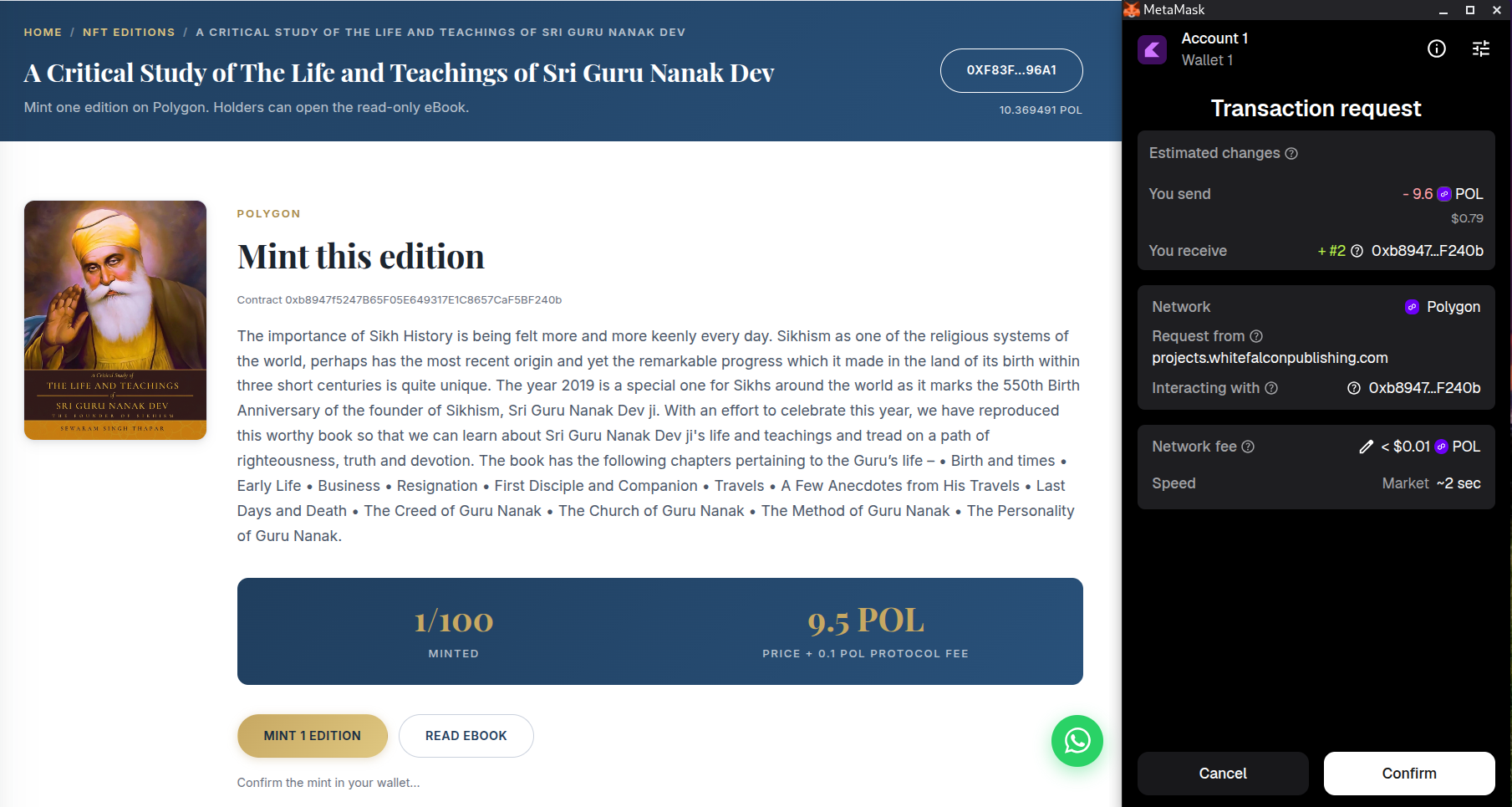
On our minting page, the reader connects a wallet on the collection’s network and confirms the mint.

3

A numbered copy is created

The blockchain records a new ERC-721 token to that wallet: one of a limited run, not an unlimited download.

4

The eBook unlocks

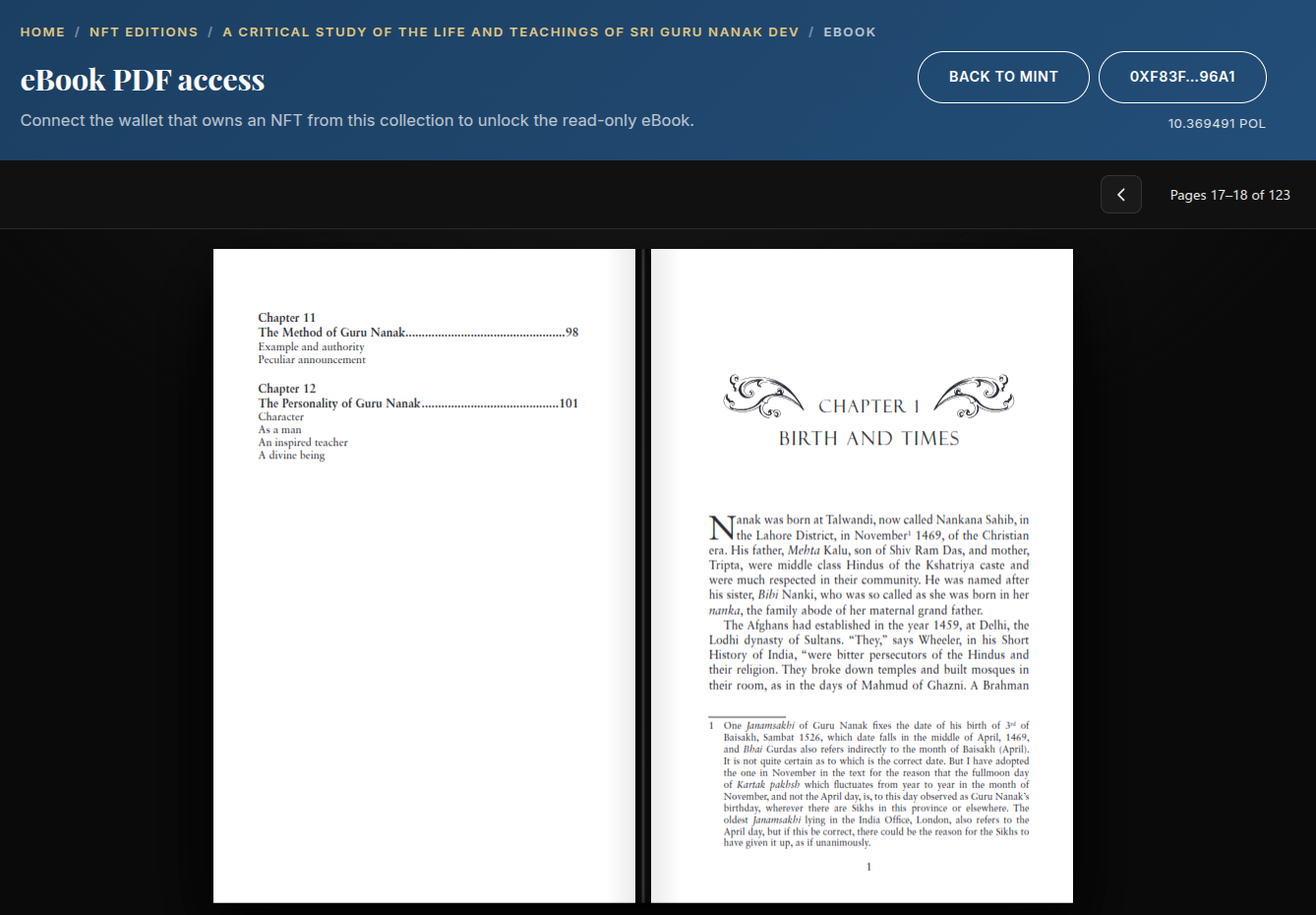
Ownership is checked on-chain. Holders open the read-only eBook; if the token is transferred, access moves with it.

Why it matters

Benefits for authors and readers

Scarcity, provenance and a direct relationship with the people who collect the work.

For authors

A true limited edition

Print runs have always had a last copy. Digital files usually do not. An editions NFT restores that: you set how many copies exist. Primary mint income is transparent. The author receives 80% of the primary mint share and 80% of secondary royalties, paid to the author’s wallet and enforced with ERC-721C so compliant marketplaces cannot skip the fee. Each holder is a known collector of that title, not an anonymous download.

For readers

A collectible you actually own

You receive a numbered copy in your wallet, not a licence that vanishes if a store closes. The eBook is gated to that ownership. You can keep the edition, gift it, or sell it; the next owner inherits both the collectible and reading access. Compatible wallets and marketplaces already understand ERC-721.

Collectible, not just a file

These are limited edition eBooks. The token is the collectible; the PDF is the reading experience reserved for holders.

Access follows the token

Our reader checks the connected wallet on-chain. No extra account is required beyond the wallet that minted or received the edition.

Open and inspectable

Anyone can verify supply, ownership and transfers on a block explorer. The edition size is part of the collection, not a private database.

Reference

Frequently Asked Questions

A plain-language guide if you have not used a wallet or an NFT before.

What is a Book NFT, in simple terms?

Think of a signed, numbered print of a book, except the certificate lives on a public blockchain instead of a slip of paper. You pay to mint one copy of a limited run. That copy is yours. While you hold it, you can open the read-only eBook on our site. If you give or sell the copy, reading access moves with it.

Do I need to understand blockchain to use this?

No. You need a browser wallet (we suggest MetaMask or a similar injected wallet), a little of the network’s currency for the mint price and network fee, and the same comfort you would need to confirm a card payment. The blockchain is the ledger in the background. You do not need to run a node or write code.

What is a wallet?

A blockchain wallet is an app (browser extension or phone) that holds your address and lets you approve transactions. It is closer to a key ring than to a bank account. The Book NFT is sent to that address. Keep the wallet’s recovery phrase private; anyone who has it can move your edition.

What do I actually receive when I mint?

You receive one ERC-721 token from that book’s collection, for example BOOK #12. The token is the collectible. It is recorded on the chain, visible in your wallet, and usable on marketplaces that support the collection. It is not a substitute for copyright, and it is not an unlimited PDF you can post publicly. The eBook is unlocked for the wallet that currently owns the token.

How do I read the eBook?

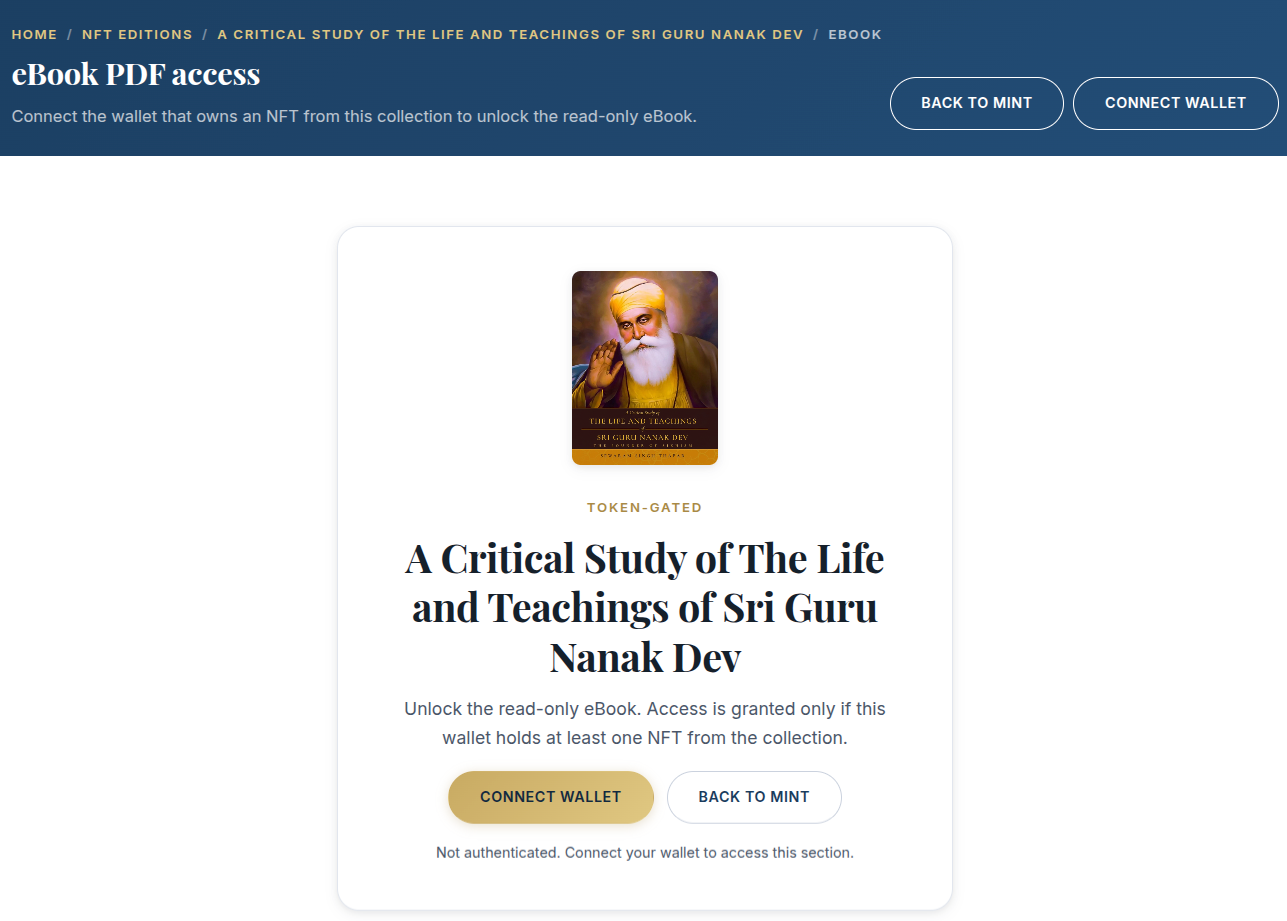
Open the book’s page on our minting site and connect the wallet that holds the edition. We check on-chain whether that address owns at least one token from the collection (token-gating). If it does, the read-only viewer opens. You do not create a separate White Falcon login for this. If you no longer hold the token, access stops.

How many copies of a title exist?

Each title is an editions collection: one book, a fixed number of identical numbered copies. The edition size is set when the collection is issued (for example 100). Once that number is minted, no more public copies of that run are created. That is what makes it a limited edition rather than a file anyone can copy.

How is this different from buying an ordinary eBook?

An ordinary eBook is usually a licence in a store account. If the store closes or the account is locked, the file can disappear. A Book NFT is a numbered item you hold. Supply is public. You can keep it, gift it, or sell it. The next owner inherits both the collectible and the reading access.

Who is paid when I mint, and who is paid if I resell?

The first purchase (the mint) is the primary sale. That mint price is split as configured for the title. The author receives 80% of the primary mint share, paid to the author’s wallet.

If you later sell or transfer the edition on a marketplace, that is a secondary sale. A royalty is taken from that resale. The author receives 80% of that secondary royalty, again to the author’s wallet. ERC-721C enforced royalties keep compliant marketplaces from skipping the fee.

How are royalties on resales enforced?

Many marketplaces treat creator royalties as optional. Book NFT collections use ERC-721C enforced royalties (creator-fee enforcement). The contract is set so that transfers through venues that refuse to pay the royalty are blocked. Compatible markets (including OpenSea and Magic Eden where this mechanism is supported) honour the fee. The author’s 80% share of that royalty is paid to the author’s wallet.

Enforcement can reduce where the token can be listed, because venues that ignore royalties cannot complete the transfer. That trade-off is intentional: it keeps the author’s resale royalty attached to the edition.

What happens if I gift or sell my edition?

Ownership of the token moves to the new wallet. Reading access follows that wallet. On a sale through an enforced marketplace, the author’s royalty is paid automatically as described above. A wallet-to-wallet gift between two people (not through a marketplace) is still a transfer of the collectible and of eBook access.

Which network do I need to be on?

Each collection is issued on a specific network (for example Polygon for live titles, or Sepolia while we test). The mint page asks your wallet to switch to the correct network. You need a small amount of that network’s currency to pay the mint price and the network fee.

How do I start?

Install a wallet, open the NFT books page, choose a title, connect, and mint one edition. When the transaction confirms, use the same wallet on that title’s eBook page to read.

Is there anything else I should know before I mint?

This page provides a description of the Book NFT and the benefits associated with it. A Book NFT is a limited-edition digital book collectible that may provide access to the corresponding digital edition.

The Book NFT is offered as a promotional and collectable digital benefit. It is not intended to function as a payment method or money, and it has no cash value except for any specific redemption benefit expressly described by the publisher. It may be used only in accordance with the terms stated on this page and may not be exchanged for cash.

Before minting or purchasing, please make sure you understand the wallet you use, the blockchain network, transaction and network fees, and the applicable redemption, access, expiry, transfer, and technical terms. Ownership of the Book NFT does not by itself transfer copyright or other intellectual-property rights in the book. Rules may differ depending on where you live. If you are unsure about the terms or implications of minting or purchasing, please obtain independent professional advice before proceeding.

In line with our mission

From hybrid print-on-demand to blockchain certification of manuscripts, White Falcon Publishing builds the infrastructure authors actually use. Book NFTs extend that work: a fair, modern way to issue a scarce digital edition without locking readers into a closed bookstore account. The collection is yours to collect; the story is yours to read.

Explore the editions

Browse live Book NFT collections, connect your wallet, and mint a numbered eBook collectible.